LongCat-2.0
A model documented in the meituan-longcat GitHub organization and exposed through the LongCat publisher API platform.
An independent overview of the LongCat open-source model family, built by Meituan. This guide covers every LongCat model — from the trillion-parameter LongCat-2.0 to LongCat-Image for image generation and LongCat-AudioDiT for text-to-speech — with source-attributed architecture details, access options, and API pricing.
Independent third-party resource. Not affiliated with, endorsed by, or sponsored by Meituan or LongCat. See the disclaimer and about page.
A model documented in the meituan-longcat GitHub organization and exposed through the LongCat publisher API platform.
A model documented in the meituan-longcat GitHub organization.
A 560-billion-parameter Mixture-of-Experts language model with dynamic computation, averaging 27B activated parameters per token. Built for high-throughput chat and agentic tasks.
A 6-billion-parameter bilingual image generation and editing model covering all 8,105 standard Chinese characters, with open-source SOTA on image editing benchmarks.
A 560B-parameter open-source omni-modal model with 27B activated, excelling at real-time audio-visual interaction — text, image, audio, and video in a single end-to-end framework.
A non-autoregressive diffusion text-to-speech model operating directly in waveform latent space, with 1B and 3.5B variants achieving SOTA zero-shot voice cloning.
A 560B-parameter open-source MoE reasoning model with domain-parallel training, DORA asynchronous RL, and 64.5% token reduction on AIME-25.
A 68.5B-parameter efficient MoE model activating ~3B per token, optimized for inference speed with N-gram embedding and strong agentic coding.
An audio-driven digital human framework with Whisper Large encoding, RLHF, and 8 NFE distillation for production-grade avatar generation.
A discrete native multimodal model unifying text, vision, and audio under a single autoregressive objective via the DiNA framework.
A 560B-parameter open-source MoE model for formal mathematics and theorem proving in Lean4 — decomposing proofs into auto-formalization, sketching, and proving with tool-integrated reasoning.
In-Depth Overview
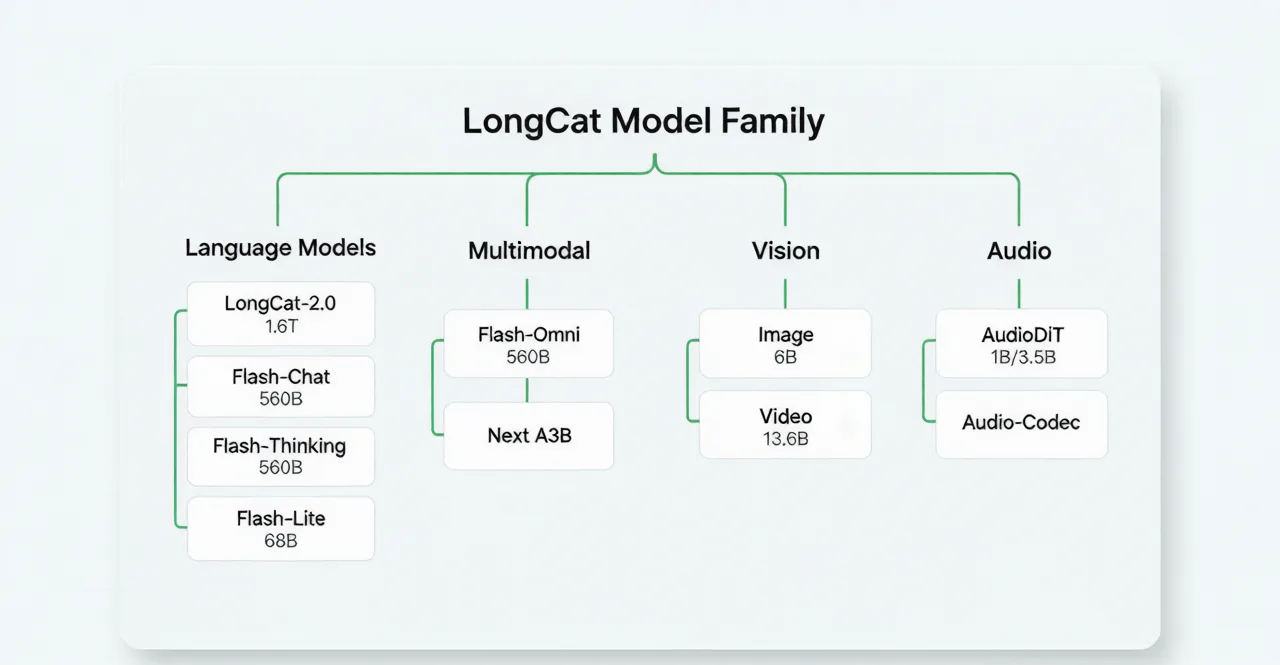
The LongCat AI model family is organized into four branches. The language model branch includes the flagship LongCat-2.0 (1.6 trillion total parameters, ~48 billion activated per token) and the LongCat-Flash series — Flash-Chat (560B), Flash-Thinking (560B with reasoning), and Flash-Lite (68.5B lightweight). The multimodal branch features LongCat-Flash-Omni, a real-time audio-visual interaction model, and LongCat-Next, a discrete native multimodal model built on the DiNA framework. The vision branch covers LongCat-Image (6B image generation and editing, covering all 8,105 standard Chinese characters), LongCat-Video (13.6B, supporting text-to-video, image-to-video, and video continuation at 720p 30fps), and LongCat-Video-Avatar 1.5 for audio-driven digital humans. The audio branch includes LongCat-AudioDiT (1B/3.5B zero-shot voice cloning TTS) and LongCat-Audio-Codec (low-bitrate streaming audio tokenization).
All LongCat open source models are released under the MIT License and available on HuggingFace, GitHub, and ModelScope — with SGLang and vLLM deployment support. The LongCat API platform at longcat.chat provides OpenAI-compatible and Anthropic-compatible endpoints for LongCat-2.0, with a free tier of 500,000 tokens per day.
For detailed profiles with verified source links, see the individual model pages above. For hands-on developer setup instructions, see the LongCat Guides section.
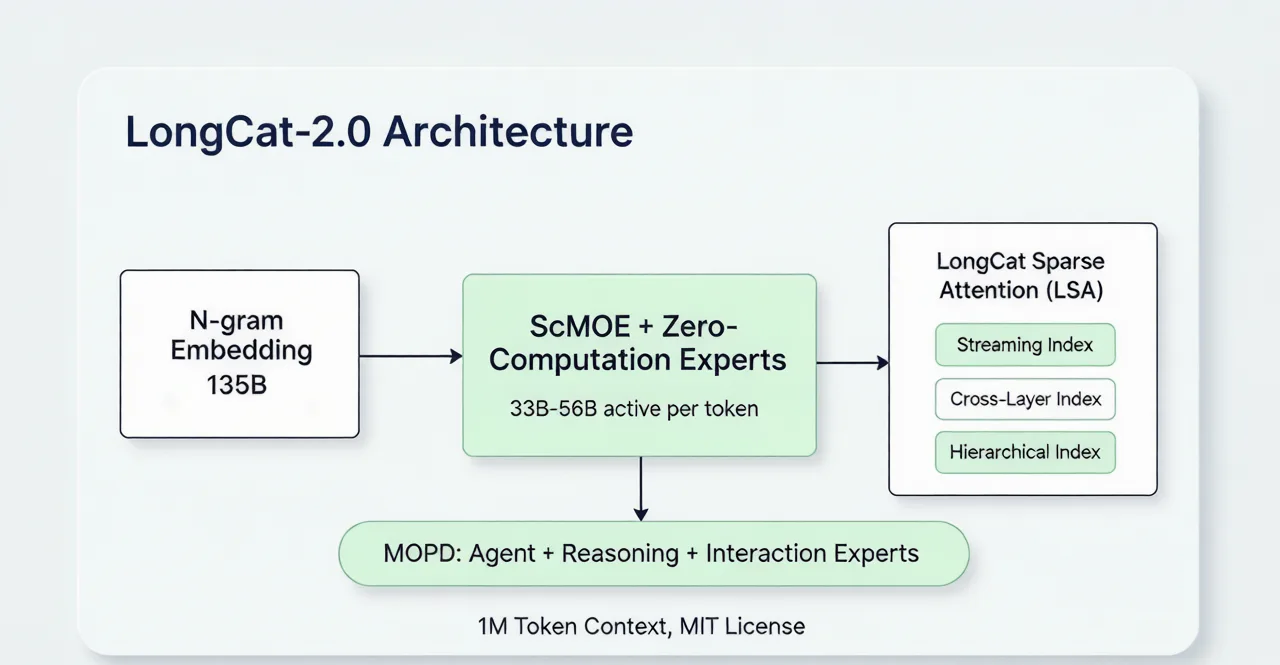
LongCat-2.0 is a 1.6-trillion-parameter Mixture-of-Experts (MoE) language model with approximately 48 billion active parameters per token (dynamic range 33B–56B). It natively supports a 1-million-token context window through LongCat Sparse Attention (LSA), which reduces attention computation from quadratic to linear complexity using Streaming-aware Indexing, Cross-Layer Indexing, and Hierarchical Indexing. The model was pre-trained on over 35 trillion tokens across a cluster of 50,000 domestic AI ASICs — described as the first trillion-parameter model to complete full training and inference without NVIDIA GPUs.
Key architectural innovations in this LongCat AI model include Zero-Computation Experts (dynamically skipping computation for simple tokens), an N-gram Embedding module (135 billion additional parameters through 5-gram token combinations), and MOPD (Multi-Teacher On-Policy Distillation) that fuses Agent, Reasoning, and Interaction expert clusters. On agentic coding benchmarks, LongCat-2.0 scores 59.5 on SWE-bench Pro and 70.8 on Terminal-Bench 2.1.
The LongCat 2.0 model launched anonymously on OpenRouter as "Owl Alpha" for two months before its public reveal in June 2026. During that period, it ranked among the top three models globally by daily token volume and ranked first on Hermes Agent, second on Claude Code, and third on OpenClaw by monthly call volume. Its monthly token throughput reached approximately 11 trillion tokens with 200% month-over-month growth.
Access LongCat-2.0: Chat for free at longcat.ai, or call the API at api.longcat.chat (OpenAI and Anthropic compatible). MIT-licensed weights are available on HuggingFace (BF16, FP8, INT8 variants). See our full LongCat-2.0 model profile for detailed capabilities and source links.
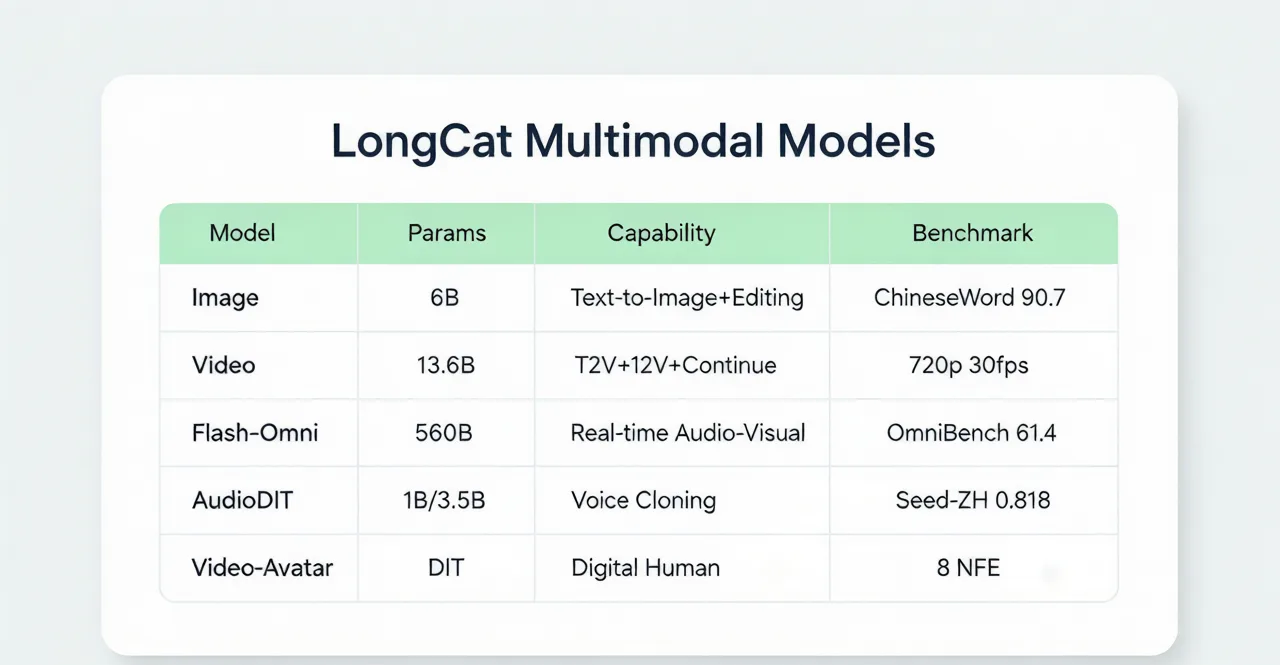
Beyond language models, the LongCat open source model family includes dedicated models for image, video, and audio generation. LongCat-Image is a 6-billion-parameter bilingual (Chinese-English) image generation and editing model. Its compact MM-DiT + Single-DiT architecture achieves open-source state-of-the-art results on image editing benchmarks (ImgEdit-Bench 4.50, GEdit-Bench 7.60/7.64) and Chinese text rendering (ChineseWord 90.7), supporting all 8,105 standard Chinese characters — a coverage level the publisher reports exceeds both major open-source and commercial alternatives.
LongCat-Video is a 13.6-billion-parameter Diffusion Transformer (DiT) model that unifies text-to-video, image-to-video, and video continuation tasks in a single framework. It generates 720p video at 30 frames per second within minutes, using a coarse-to-fine generation strategy and Block Sparse Attention for efficiency. LongCat-Video-Avatar 1.5, built on the same DiT foundation, provides audio-driven digital human generation with Whisper Large audio encoding and step distillation to 8 NFE for production deployment.
For LongCat text to speech, LongCat-AudioDiT operates directly in the waveform latent space — bypassing traditional mel-spectrogram intermediates — using a Wav-VAE encoder and a Diffusion Transformer backbone. The 3.5-billion-parameter variant achieves a speaker similarity score of 0.818 on Seed-ZH and 0.797 on Seed-Hard, trained on 1 million hours of Chinese and English speech data.
| Model | Parameters | Primary Capability | Key Metric |
|---|---|---|---|
| LongCat-Image | 6B | Text-to-image generation & editing | ChineseWord 90.7 |
| LongCat-Video | 13.6B | Text-to-video, image-to-video, continuation | 720p 30fps |
| LongCat-Flash-Omni | 560B (27B active) | Real-time audio-visual interaction | OmniBench 61.38 |
| LongCat-AudioDiT | 1B / 3.5B | Zero-shot voice cloning (TTS) | Seed-ZH SIM 0.818 |
| LongCat-Video-Avatar 1.5 | DiT-based | Audio-driven digital human | 8 NFE distilled |
There are several ways to try LongCat for free online. The official LongCat chat interface at longcat.ai provides browser-based access to LongCat-2.0 and LongCat-Flash models at no cost, supporting text conversation, file uploads, and voice calls. The LongCat App (available on iOS via the App Store, and on Android) extends this with mobile-optimized chat, image generation and editing, and real-time voice interaction — powered by LongCat-Image and LongCat-Flash-Omni.
Developers can access the LongCat API through the LongCat API platform at longcat.chat. The API is compatible with both the OpenAI SDK (endpoint: api.longcat.chat/openai/v1/chat/completions) and the Anthropic SDK (endpoint: api.longcat.chat/anthropic/v1/messages). Each account receives 500,000 free tokens per day by default, with an option to apply for an increase to 5,000,000 tokens per day. See the LongCat API Quick Start guide for detailed setup instructions.
LongCat-2.0 is also available through OpenRouter, a third-party API routing platform. Developers using Claude Code can route LongCat-2.0 through the Anthropic-compatible endpoint — documented in the LongCat with Claude Code setup guide. Other productivity integrations include OpenClaw, Hermes, Kilo Code, and OpenCode.
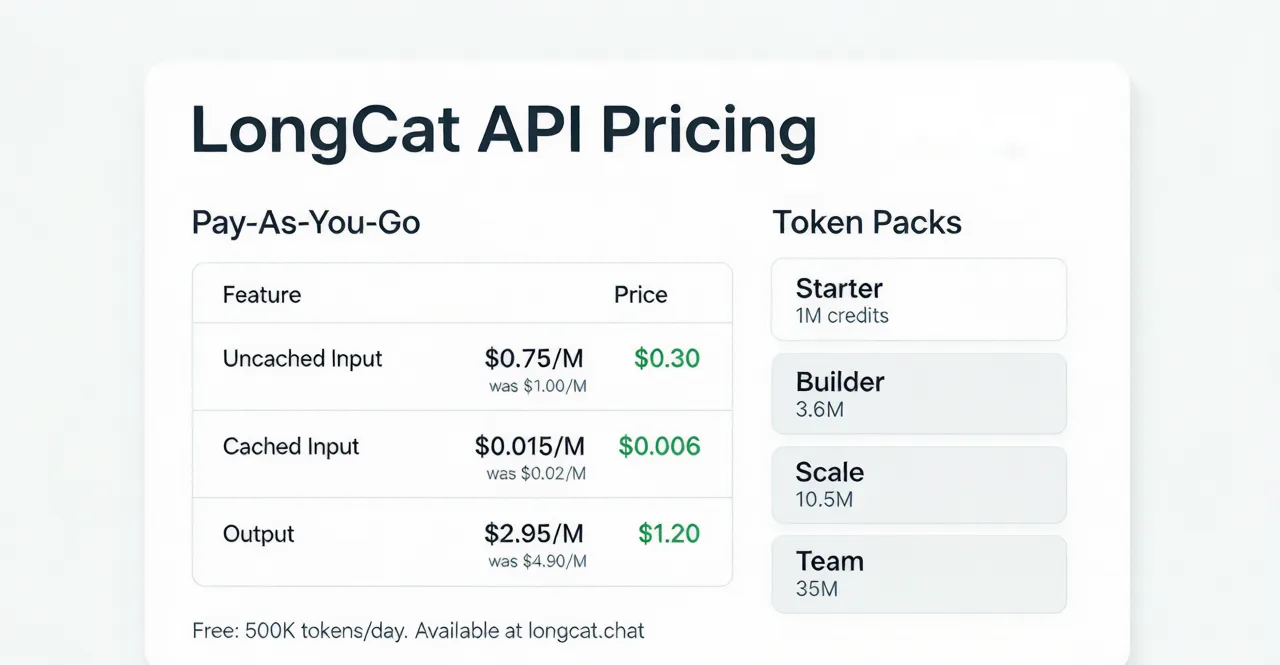
The LongCat API pricing follows a pay-as-you-go model with no minimum commitment. According to the publisher's documentation, the following rates apply to LongCat-2.0 (limited-time discounted prices shown):
| Pricing Item | Original Price | Discounted Price |
|---|---|---|
| Uncached Input | $0.75 / 1M tokens | $0.30 / 1M tokens |
| Cached Input | $0.015 / 1M tokens | $0.006 / 1M tokens |
| Output | $2.95 / 1M tokens | $1.20 / 1M tokens |
In addition to pay-as-you-go, one-time token packs (valid 30 days):
The platform provides 500,000 free tokens per day (default), with an application-based increase to 5,000,000 tokens per day. Recharged balances do not expire. The discounted LongCat pricing rates are described by the publisher as a platform launch promotion — always confirm current rates at longcat.chat before budgeting.
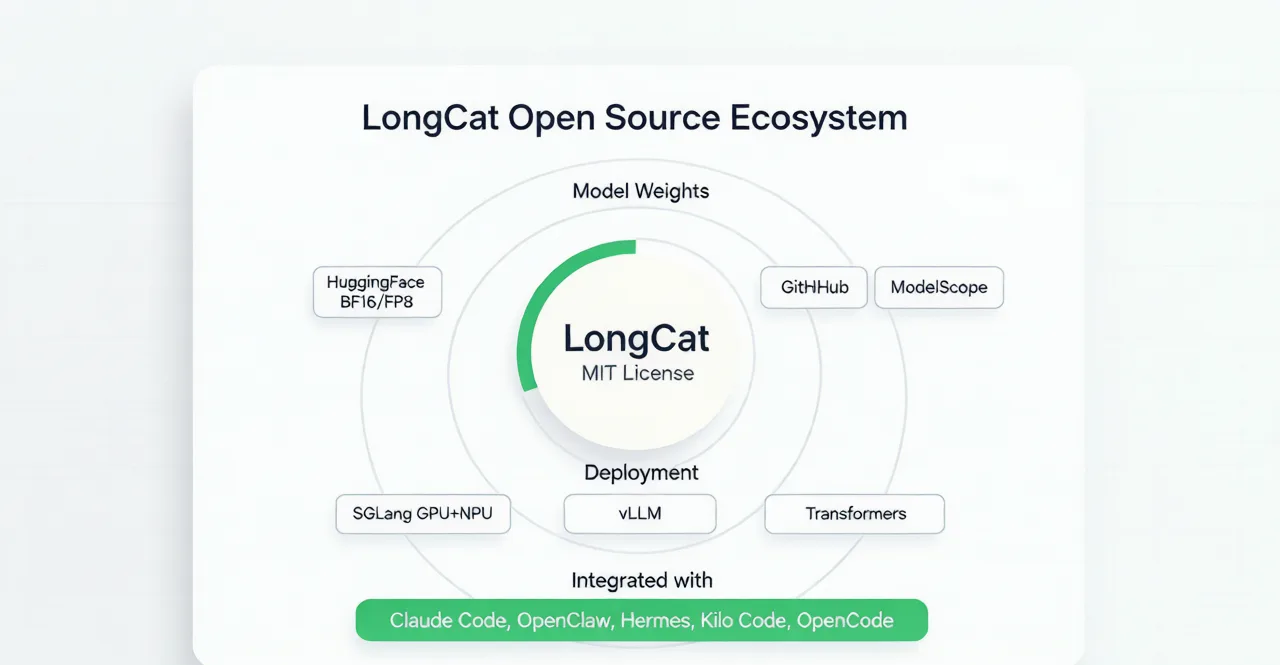
The entire LongCat open source model family is released under the MIT License, which permits commercial use, modification, redistribution, and model distillation. Weights are distributed across three platforms: HuggingFace (meituan-longcat organization, with BF16, FP8, and INT8 precision variants), GitHub (all model repositories including inference code for GPU and NPU), and ModelScope (meituan-longcat collection).
For self-hosted deployment, LongCat open source models support SGLang and vLLM as the primary serving frameworks. The SGLang project includes a dedicated PR (#30042) for LongCat-2.0 GPU inference with a recommended configuration of 16x H20 GPUs. A separate NPU inference repository (meituan-longcat/SGLang-FluentLLM) provides optimized inference on domestic AI accelerators. The models are also compatible with Hugging Face Transformers via trust_remote_code loading.
LongCat models are integrated with leading developer tools including Claude Code (LongCat-2.0 ranked second in monthly call volume through Claude Code on OpenRouter), OpenClaw (with a dedicated LongCat provider plugin), Hermes Agent (ranked first by monthly call volume on OpenRouter), Kilo Code, and OpenCode.
The LongCat architecture is built on several innovations documented in the LongCat-Flash technical report (arXiv:2509.01322). The Shortcut-connected Mixture of Experts (ScMoE) design enlarges the computation-communication overlap window, enabling training at tens-of-thousands-of-accelerators scale while maintaining inference throughput above 100 tokens per second on H800 GPUs. Zero-Computation Experts introduce a dummy expert that handles simple tokens with zero compute cost, with a PID controller dynamically adjusting expert bias to maintain an average activation of ~27 billion parameters per token.
For long-context processing, two sparse attention mechanisms have been published: LongCat ZigZag Attention (LoZA, arXiv:2512.23966) for general-purpose sparse attention, and LongCat Sparse Attention (LSA) — deployed in LongCat-2.0 — using three-tier indexing (Streaming, Cross-Layer, Hierarchical) to reduce attention complexity from quadratic to near-linear. The DORA (Dynamic ORchestration for Asynchronous rollout) RL framework supports training across over 10,000 environments spanning more than 20 domains, with a reported threefold speedup over synchronous methods.